Simplify Your Shipping: Introducing Collection Shipping Codes & Global Shipping Rates

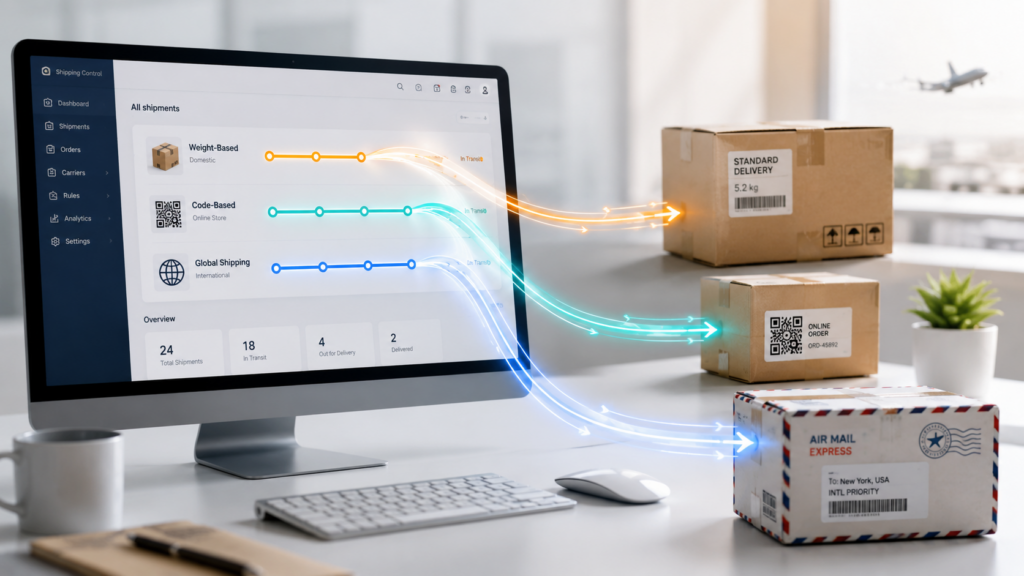
Two new shipping features are introduced for online stores: Collection Shipping Codes and Global Shipping Rates. Collection codes apply shipping rules to all products in a collection, with product-level codes overriding collection settings and standard rates used as a fallback.

Global Shipping Rates apply to every item in the cart and can be used for simple options like local pickup. The post explains how the features work together at checkout and notes that existing shipping methods continue to function as before.

Shipping your products to customers is one of the most important parts of running an online store — but it can also be one of the most complicated. That’s why we’re excited to announce two powerful new features designed to give you more control and make checkout smoother for your customers: Collection Shipping Codes and Global Shipping Rates.

Whether you sell everything from small books to fragile glassware, or you offer local pickup alongside standard delivery, these new tools make it easier than ever to manage shipping the way your business works.

Collection Shipping Codes: Set It Once, Apply Everywhere

Before now, if you wanted to apply special shipping rules to a group of products — say, a “Fragile” surcharge or a flat rate for heavy items — you had to assign a shipping code to each product individually. For stores with dozens or hundreds of products, that meant hours of repetitive setup.

With Collection Shipping Codes, you can now assign a shipping code directly to a collection. Any product inside that collection automatically inherits the shipping code. No more clicking through every single product variation.

How it works

You can assign shipping codes at three levels, and the system follows a clear hierarchy:

  1. Product or Variation level (highest priority) — if a specific product has its own code, that takes precedence.
  2. Collection level (new!) — if a product belongs to a collection with a shipping code, that code is applied automatically.
  3. Standard weight/price-based rates (default) — if no shipping code is assigned, the system falls back to your standard rates.

This means you get the best of both worlds: bulk efficiency for most products, with the flexibility to override individual items when needed.

What makes it even better?

A single collection can have multiple shipping codes assigned to it. For example, your “Gift Wrapping” collection might use one code, while your “Fragile Items” collection uses another. When a customer checks out with items from both collections, the shipping rates are grouped by code — so the customer sees separate shipping options for each group. This often results in separate parcels being sent based on handling requirements, which is exactly what you want for fragile or specially handled products.

Global Shipping Rates: One Rate to Rule Them All

Sometimes you don’t need complex rules at all. Sometimes you just need a simple, universal option — like free local pickup, or a flat rate for everything.

That’s where Global Shipping Rates come in.

A global shipping rate applies to all items in the cart, regardless of any shipping codes assigned to products or collections. It sits above everything else and gives you a clean, catch-all solution for straightforward shipping scenarios.

Perfect for Local Pickup

The most common use case? Local pickup. Simply set up a global rate of $0.00 and label it “Local Pickup” or “Free In-Store Collection.” Customers who choose it get charged nothing for shipping — and the experience is seamless.

Smart checkout behaviour

When a customer selects a global rate, all other shipping code groups are automatically hidden. If they change their mind and switch back to a non-global rate, the shipping code groups reappear instantly. The system keeps things tidy so your customers always see the right options at the right time.

Putting It All Together

Here’s how these features work together in a real-world scenario:

Imagine you run a store that sells:

  • Everyday products (books, clothing, accessories) — shipped using your standard weight-based rates.
  • Fragile items (glassware, ceramics) — flagged with a “Fragile” shipping code so customers see a separate handling fee.
  • Gift vouchers — shipped digitally with no shipping cost.
  • Local pickup — offered as a global rate at $0.00.

With the new Collection Shipping Codes, you assign the “Fragile” code to your Ceramics collection in seconds. With Global Shipping Rates, you add a free local pickup option that works across the entire store. And because the system handles the logic for you, your customers simply see the right shipping options at checkout — no confusion, no guesswork.

Why You’ll Love These Features

  • Save time: Assign shipping rules to entire collections instead of individual products.
  • Stay flexible: Override collection defaults on a per-product basis when you need to.
  • Simplify checkout: Global rates keep things clean for straightforward scenarios like local pickup.
  • Separate handling: Different shipping codes create separate groups at checkout, so customers see exactly what they’re paying for.
  • No disruption: These features build on top of the shipping methods you already use — weight-based, price-based, and shipping agent integrations still work exactly as before.

Ready to Get Started?

Head over to your store settings and explore the new shipping options under your product and collection pages. Whether you’re streamlining your existing setup or building something new from scratch, Collection Shipping Codes and Global Shipping Rates are here to make your life easier.

Happy selling! 🚀

Spiffy Stores AICommerce Platform – AI as Core Infrastructure

Moving Beyond “Add-On AI”

In 2025, it feels like every e-commerce platform is suddenly “AI-powered”.

Open almost any dashboard and you’ll find a new button labelled “Generate product description” or “Ask our AI assistant”. Behind the scenes, these tools often rely on external APIs or third-party chatbot companies, bolt-on integrations that offer isolated functionality without truly understanding the store, its products or its customers.

These features are usually built as apps or plug-ins, running on separate systems that have limited access to store data. They can create short bursts of convenience, a few lines of copy here, a quick image prompt there, but they don’t fundamentally change how the store operates. They’re like attaching a high-tech gadget to a 10-year-old engine: impressive on the surface, but still disconnected from the machinery that drives real commerce.


The Spiffy Stores Difference — AICommerce by Design

At Spiffy Stores, we’ve taken a completely different approach.

Instead of bolting AI tools onto an existing platform, we’ve rebuilt core parts of the system to integrate artificial intelligence directly into the store’s infrastructure — what we call AICommerce.

AICommerce isn’t just about automating tasks; it’s about transforming how a store thinks and adapts. By embedding AI models into the platform itself, Spiffy Stores enables intelligent decision-making at every layer, from product recommendations and search to SEO optimisation and store analytics.

Where other platforms treat AI as a separate app, Spiffy’s AI lives inside the platform, learning from the same data that powers your sales, inventory and customer interactions. This means better results, faster performance and zero dependency on third-party services that may change terms, pricing or availability without notice.


AI at the Infrastructure Level

Spiffy’s AICommerce platform integrates advanced AI capabilities natively, not through calls to external third-party APIs and services, but through purpose-built infrastructure designed for scalability, privacy and performance.

Examples include:

  • AI-Driven Product Recommendations:
    Instead of relying on manual product tags or rule-based systems, Spiffy’s AI analyses product descriptions, attributes and sales behaviour to generate intelligent product recommendations automatically, unique for each store and constantly improving over time.
  • Automatic Meta Tag and Description Generation:
    Every product and collection can have short, keyword-optimised meta tags generated in seconds, enhancing SEO without requiring manual editing or external copywriting tools.
  • Context-Aware Store Search:
    AICommerce enhances product discovery by understanding meaning and intent, not just keywords. Customers get results that make sense semantically, even if the search terms don’t exactly match product titles.
  • AI Insights and Optimisation:
    With AI built into the store backend, analytics aren’t just reports, they’re insights. The system can highlight trends, predict product performance and recommend actions that improve conversion and engagement.

Why Integration Matters

When AI is built as part of the platform rather than added as an afterthought, the benefits compound:

  • Speed & Stability: AI operations run directly on Spiffy’s infrastructure, no waiting for third-party APIs to respond or fail.
  • Privacy & Control: Your store data never leaves Spiffy’s secure environment.
  • Cost Efficiency: No external subscriptions or hidden “per-use” fees from app marketplaces.
  • Ease of Use: As a store owner, you don’t need to configure and manage any external services, such as an AI chatbot, trying to ensure that your store data is replicated and current on the external service’s data stores.
  • Future-Proof: As AI models evolve, the platform evolves with them, no need to install new apps or chase compatibility updates.

This integration-first approach turns AI from a marketing buzzword into a real competitive advantage.


A Local Vision for Global Technology

Just as importantly, Spiffy Stores is Australian-owned and operated, building technology locally to serve the needs of Australian merchants.

While global platforms chase the latest trend, Spiffy focuses on meaningful innovation, creating an ecosystem where store owners benefit directly from the advances in AI without losing control of their data or their independence.


The Future of AICommerce

AICommerce represents the next evolution of e-commerce, a world where the store itself is intelligent, adaptive and continuously improving. Spiffy Stores isn’t simply adding AI features; it’s redefining how online stores are built, managed and grown.

If you’ve ever wanted your store to feel like it runs itself, making smarter product suggestions, writing better descriptions and optimising its own performance — that’s AICommerce.


Spiffy Stores — powering the next generation of intelligent online stores.

Learn more at https://www.spiffystores.com.au

Spiffy Stores vs Shopify: Which Works Best for Australian Merchants?

When you’re setting up or growing your online store in Australia, you’ll come across two very different options: Shopify, the global ecommerce giant, and Spiffy Stores, a local Australian platform built specifically for SMBs.

Both can power your online store — but they approach ecommerce differently. Below we break down the differences feature by feature, so you can decide which platform aligns best with your needs.


1. Setup & Onboarding

  • Spiffy Stores: Quick-start setup wizard, localised defaults, Australian tax/shipping options out of the box. Ideal for merchants who want to launch quickly with minimal fuss.
  • Shopify: Polished onboarding flow, lots of setup options (Shopify Payments, Markets, POS), but more complexity. Can feel overwhelming if you just want to start selling locally.

Best for: Speed and simplicity → Spiffy. Flexibility for complex setups → Shopify.


2. Themes & Design Control

  • Spiffy Stores: Mobile-optimised themes, adjustable settings, built-in editor for HTML/CSS. Developers can customise fully, or Spiffy can perform paid template edits for you.
  • Shopify: 100+ professional themes, advanced drag-and-drop customiser, huge third-party theme marketplace, strong ecosystem of design agencies.

Best for: Simple, functional sites → Spiffy. High-end design & branding flexibility → Shopify.


3. Payments & Gateways

  • Spiffy Stores: Strong local support — eWAY, Pin Payments, SecurePay, PayPal, Afterpay, Zip Pay, Square Payments, Stripe, plus bank merchant facilities. No extra transaction fees for using external gateways.
  • Shopify: Shopify Payments (where supported), PayPal, Afterpay, Klarna, plus 100+ gateways worldwide. If you don’t use Shopify Payments, extra transaction fees apply.

Best for: Australian merchants who want choice without fees → Spiffy. Global merchants needing multiple currencies → Shopify.


4. Shipping & Taxes

  • Spiffy Stores: Integrated Australia Post, Sendle and Aramex rates, local tax handling, GST-friendly settings.
  • Shopify: Wide carrier integrations, third-party shipping apps, sophisticated international tax and duties handling.

Best for: Domestic-focused sellers → Spiffy. Cross-border/multi-country sellers → Shopify.


5. Apps & Extensions

  • Spiffy Stores: Lean ecosystem — many everyday features are built-in (discounts, gift certificates, bundles, infinite options, blogging, reviews, analytics). Advanced needs often handled by Spiffy developers via template edits.
  • Shopify: 8,000+ apps in the App Store (subscriptions, loyalty, wholesale portals, advanced marketing). Adds cost but unmatched breadth.

Best for: Simplicity without app overload → Spiffy. Cutting-edge integrations → Shopify.


6. Marketing & SEO

  • Spiffy Stores: Built-in blogging, SEO fields, Google Analytics/GA4 integration, Klavio, Facebook/Instagram shop integration.
  • Shopify: More advanced SEO tools, large ecosystem of marketing apps, powerful multi-channel selling (TikTok, YouTube, Amazon, eBay, POS).

Best for: Core SEO + social media → Spiffy. Full omnichannel selling → Shopify.


7. Support

  • Spiffy Stores: Australian-based support team, available via email and phone, with remote screen-sharing (TeamViewer) if needed. AI Chatbot to assist with technical questions. Practical, personal, and in your timezone.
  • Shopify: 24/7 global support via chat only. No more phone or email support. Large help centre, and a huge global partner network.

Best for: Personal, local, SMB-focused support → Spiffy. Scalable, global network → Shopify.


8. Pricing

  • Spiffy Stores: Lower, predictable monthly fees in Australian dollars. Many features included by default. Fewer add-on costs. Starts at $25 per month, incluuding GST.
  • Shopify: Tiered monthly pricing. Many core features require apps, which adds to costs. Extra transaction fees if not using Shopify Payments. Starts at $61.60 per month, including GST.

Best for: Budget-conscious SMBs → Spiffy. Merchants who can justify app costs for growth → Shopify.


9. Scalability

  • Spiffy Stores: Best fit for small-to-medium businesses focused on the Australian market.
  • Shopify: Can scale from startup to enterprise (Shopify Plus), with multi-currency, headless commerce, APIs, and complex integrations.

Best for: Local growth → Spiffy. International expansion → Shopify.


10. Philosophy & Roadmap

  • Spiffy Stores: Keeps things lean and merchant-friendly, with local integrations and hands-on help.
  • Shopify: Fast-moving roadmap with advanced commerce features, and global market expansion.

Best for: Stability and simplicity → Spiffy. Access to cutting-edge ecommerce innovations → Shopify.


Summary: Which Should You Choose?

  • Choose Spiffy Stores if… you’re a small-to-medium Australian business, want personal support, predictable costs, and built-in tools without a big learning curve.
  • Choose Shopify if… you plan to scale internationally, need advanced integrations, or want access to the largest app ecosystem in ecommerce.

Supporting Spiffy Stores also means supporting a local Australian business, keeping your subscription dollars in the country, and working with a support team who understands the local market first-hand.

Announcing PayPal Checkout with One-Click Onboarding

We’re excited to announce that PayPal Checkout is now available on Spiffy Stores — with a streamlined, one-click onboarding process that makes it faster and easier than ever to start accepting payments.

Why PayPal Checkout?

PayPal Checkout gives your customers more ways to pay securely, without leaving your store. When a shopper chooses PayPal at checkout, a secure PayPal window opens where they can:

  • ✅ Log in and pay with their PayPal account
  • ✅ Pay by credit or debit card as a guest (no account required)
  • ✅ Choose Pay in 4 (where available) to split their purchase into four interest-free payments

As soon as the payment is confirmed, the window closes, the order is created and marked as paid, and your customer receives their confirmation email.

This smooth process is a big improvement over older PayPal integrations like Website Payments Standard, which could leave unpaid or abandoned orders in your system. With PayPal Checkout, only confirmed payments create orders — keeping your records clean and accurate.

Benefits at a Glance

  • Seamless checkout – Customers stay in your store without being redirected off-site
  • More payment choices – PayPal, debit/credit card (guest checkout), or Pay in 4 installments
  • Free Pay in 4 – No extra fees for customers to use installments
  • No unpaid orders – Orders only appear after confirmed payment
  • One-click setup – Automatic onboarding, no manual credentials needed
  • Detailed orders – Includes a full line-item breakdown in PayPal
  • Tracking updates – Order tracking info syncs to PayPal for dispute protection
  • Future-ready – Replaces legacy methods like Website Payments Standard and Express

One-Click Onboarding

As an official PayPal partner, Spiffy Stores now supports automatic onboarding. This means you can connect your PayPal account to your store with just a single click — no technical knowledge or manual credential setup required.

All you need is a PayPal Business account. If you don’t have one yet, you can sign up during the onboarding flow. If you’re using a personal PayPal account, you’ll be prompted to upgrade by adding your business details.

Migrating from Older PayPal Integrations

If you’re currently using PayPal Website Payments Standard, PayPal Express, or even a manually configured PayPal Checkout, we strongly recommend migrating to the new version. You’ll unlock all of the benefits above while creating a faster, simpler checkout for your customers.

The migration is straightforward:

  1. Note down your current PayPal settings.
  2. Deactivate your existing PayPal integration.
  3. Enable the new PayPal Checkout in your Spiffy Store Toolbox.
  4. Follow the one-click connection process to link your PayPal account.

That’s it — your store will be ready to accept payments through the new PayPal Checkout.

Ready to Get Started?

Log in to your Spiffy Store Toolbox, head to Preferences → Checkout & Payment, and select PayPal Checkout to begin.

With PayPal Checkout, you’ll be giving your customers a smoother, more flexible payment experience — and you’ll enjoy easier setup, cleaner order management, and better dispute protection.

Newsletter Aug 2025 – We’ve been working hard for you!

Here are the latest updates from Spiffy Stores…
Shipping Rates Insurance Cover

First up, we have a great new addition to our shipping rates, automatic insurance cover for weight-based rates.

For example, if you need to ship similar items, one worth $5 and the other $500, then using the traditional methods used by every other ecommerce platform, your going to charge your customer exactly the same shipping rate.

Bad luck if your carrier loses the $500 item!

But no more. Our new Insurance Cover feature lets you define an amount for included cover, extra cover and the fee for extra cover. This means that when the value of the items you are shipping together in a parcel exceeds the included cover, the shipping rate will be increased automatically by adding the fee required to provide the amount of extra cover needed.

This new feature is included in all plans and is available on all weight-based shipping rates. Read more about Insurance Cover in our Knowledge Base.

Australia Post Extra Small Satchels

While on the topic of shipping, our Australia Post shipping calculator has been updated to support the new Extra Small satchels.

Meet Carter, our new Chatbot

It’s all the rage, and AI has come to Spiffy Stores. We have a new chatbot available, both on the website and in the admin interface, and he’s been trained on our entire Knowledge Base and blog articles from the past 15 years, so he’s really a bit of an expert now. Want some advice on how to do something new? Just run it by Carter and see if he can help.

That’s it for the moment, but we’ve got a lot more to let you know about, including some exciting new features that we’re putting the final touches on.

See how Spiffy Stores Delivers for you in 2025

2025 is here and you’re going to see even more ways that Spiffy Stores is delivering real solutions that you need to run a successful ecommerce business.

One of our main focuses this year is Shipping – one of the most difficult things to get right in ecommerce.

To start with, let’s have a look at Local Delivery.

Delivering to your Local Community

You’re a small business, just starting out, and you might want to encourage sales in your local community. What better way to introduce yourself than by offering free or low-cost local delivery? So how is this done?

Using Checkout Rules for Local Delivery

You may not be aware of it, but Spiffy Stores has a very advanced rules-based feature that allows you to control various aspects of the checkout process. This feature is called “Checkout Rules” and is included in our Pro plan, but everyone else can add it to their existing plans for just $5.00 extra per month.

Amongst its features is the ability to control what shipping rates are made available to a customer when they checkout. You have a wide range of options available, such as being able to offer special discount shipping to your VIP customers or, in this case, offer free or low-cost local delivery to anyone who lives within a certain distance of your store location.

Getting the Distance Right

Now local delivery is not really such a unique feature – you’ll find something similar in most ecommerce platforms, but they’re all going to work much the same way by calculating the distance in a straight line.

Where Spiffy Stores stands out is that we now offer a distance calculation that calculates the distance based on the actual route needed to drive between the two points.

Here’s why this is important. If you want to cover a reasonably large area to offer local delivery, then you’re bound to run into situations where the straight-line distance is far less than the actual distance needed to drive to that location. This often happens in the fringe areas of a locality where there may not be a direct route to a particular location.

If you happen to get an order from one of these remote locations, then you’re probably going to make a loss on delivering the item to that location, and that’s something that you need to avoid if possible.

More Possibilities

Once you open up the idea of measuring the actual distance between your store location and the customer’s shipping location, some new possibilties can be considered.

For example, we’re currently looking at the idea of adding distance based shipping rates. This means that you’ll be able to create a shipping rate that is calculated using a fixed rate per kilometer using the actual driving distance between your store location and the customer.

If you think this is something that would be a benefit to your store, please let us know.

Limited Use Coupon Code Discounts

Coupon Code Discounts are one of the best marketing tools around for your Spiffy Store. Customers love using coupon codes to get a special deal on their next purchase.

We’ve just added some new options to our Coupon Code Discounts that we know will help you increase your sales and gain new customers.

Firstly, you can now create a coupon code that is limited in its use based on the email address of the customer. In other words, you can now create a coupon code that can be used only once for each customer. You might be having a promotional sale on a new line of products, and you want to be able to offer a 10% introductory discount to your customers when they purchase these new products.

The new limited-use coupon code allows you to do exactly this. Any customer can use the coupon code for their first purchase of these items, and get the discount, but on subsequent orders, the discount offer will no longer be available.

Our second update to the Coupon Code Discounts is similar, except that it limits the use of the coupon code discount to only new customers. This is a great way to attract new customers. You’re able to offer them a discount or free shipping on their very first purchase, which introduces them to your store, and hopefully leads to repeat purchases in the future!

These new options are now available on all plans that include the Discounts and Coupon Codes feature, and for other plans, it is included as part of the associated add-on.

For more information and a step-by-step, check out the documentation on setting up Coupon Codes in our knowledge base.

PayPal Checkout is Here!

We’re happy to announce that PayPal’s new payments platform, PayPal Checkout, is now available on all Spiffy Stores.

This new platform brings a raft of improvements, both for you, as a merchant, and for your customers.

Your customers are going to be pleased that the new PayPal Pay in 4 payments option is now available to eligible customers, allowing them to split their payment into 4 separate payments, so that they can spread out the cost of their purchases to suit their budgets. As a merchant, you’ll receive the full payment up front, with PayPal managing the remaining payments.

You’ll be also happy to know that all the confusion between PayPal Express and PayPal Website Payments Standard has gone away. Now there’s just a single payment option that the customer can choose at payment time. What’s better is that the customer doesn’t leave the checkout page to be redirected to the PayPal site for payment. The whole payment process takes place within a pop-up window on the checkout page. This will eliminate a lot of confusion for your customers, and will hopefully improve your sales as a result.

Another terrific improvement for you, as a merchant, is that abandoned orders are a thing of the past. Under the new PayPal Checkout platform, if a customer has a change of mind, and doesn’t proceed with the payment, then an order is not created. This means that you won’t see a lot of unpaid orders popping up as customers get redirected to PayPal, and then confused by the process, and abandon their purchase, leaving you with an unpaid order to deal with. Of course, if a customer does not go through with the purchase, you still have the option of following them up with a reminder email using our Abandoned Checkouts feature.

If there’s a problem with the order, and you need to process a refund, you’ll be happy to know that the refund process is now fully integrated with PayPal. If you process a refund for a PayPal Checkout order through your Spiffy Store admin interface, then that refund will also be passed through to PayPal for processing automatically.

Finally, when you ship an order, if you add a tracking number to the order, this will automatically be added to the PayPal order as well. This will greatly improve your chances of winning any dispute with the customer, as PayPal will have a record of the tracking number and will generally find in your favour as a result.

PayPal Checkout is fairly straightforward to add to your Spiffy Store. If you are currently using the older legacy PayPal integrations, then you will need to disable them first. You can then follow our instructions in our Knowledge Base for adding PayPal Checkout to your store.

https://www.spiffystores.com.au/kb/Enabling_PayPal_Checkout

Get in synch with Square Point of Sale systems

Square is a well-known and trusted solution for many small business owners who need a Point of Sale solution. Their software and hardware options make the management of physical inventory a breeze, which is why they are a popular choice.

If your business starts to grow and you want to branch out and add an ecommerce option for sales, or vice versa, then you need to look at how you’re going to manage inventory and make sure that it all stays in synchronization between what your online store has for sale, versus what you have on the shelves in your physical store.

Here’s where Spiffy Stores can help.

We know that lots of Square POS users love their systems, but it can be difficult to find an ecommerce platform that is going to share the love. That’s why we have integrated the Square Point of Sale within our platform, to make your life as easy as possible.

It’s a simple as connecting your Square POS account to your Spiffy Stores account, selecting which products to synchronize and performing an initial synchronization. Products are then synched across to Square POS with their images and information seamlessly. Everything’s built in. There are no extra 3rd-party apps to buy and install and it’s all done in real time.

Once you’re up and running, every sale from your online store will update available inventory in your in-store POS system so that you can’t ever find yourself out of stock. Similarly, a sale in your physical store updates the inventory in your online store. A product can’t be oversold, so you now have a drama-free experience fulfilling your orders.

With Spiffy Stores and Square POS, you have the best of both worlds.

Don’t forget we’ve already integrated Square payments, so you can also accept credit card payments using your Square account in your online store.

Our Square POS integration is now available to all stores. It’s included in our Pro Plan, and is available as an add-on to all stores on other plans.

Spiffy Stores partners with Sendle to provide 100% carbon neutral delivery

Parcel delivery for small business, but better!

Hot on the heels of our integrations with Fastway and Australia Post, we’re delighted to announce our integration with Sendle… who have just recently announced they are now Climate Neutral Certified!

Sendle is the sustainable shipper specifically designed for small business. As the first 100% carbon neutral shipping service in Australia (and now the US and Canada, too), they work hard to reduce shipping’s harm on the planet. Sendle, like us, thinks that everyone, everywhere should have the opportunity and tools to build their dream business.

Each year 1 billion parcels are sent across Australia alone. And, each one of those parcels has an impact on the environment. In addition to a heap of packaging waste, tons of CO₂ are emitted into the atmosphere with every delivery. It’s a huge problem. 

By shipping with Sendle, you’re part of the solution. Every time you send a parcel, Sendle offsets the carbon emissions by investing in environmental projects. So far, they’ve helped preserve pockets of native forests in Tasmania’s Central Highlands, helped protect the Australian Long-nosed Potoroo, and are helping restore wetlands and native forests in Australia.

For us at Spiffy Stores, efficiency is the name of the game when it comes to shipping. Relying on manual processes to fulfil orders can be a recipe for disaster when things get busy.

Using shipping tools, such as our fulfilment integrations enables you to book a courier and print shipping labels automatically as part of a streamlined workflow. By simply doing this, you could get parcels out of the door 200% faster than you could by manually entering information for each parcel.

Like our other integrations, when you ship an order, your customer is automatically notified with the tracking information, you can print out all of your labels in one batch…and you’ll also be able to check on the status of each parcel until it is successfully delivered.

The difference with Sendle though, is that you can get discounted rates with a free upgrade to Sendle Premium, providing great discounted rates… as well as the peace of mind that your deliveries are 100% carbon neutral. You can take advantage of their 250g options for small or light items, Sendle Express is guaranteed cheaper than Express post, and you buy compostable satchels from them that break down in home compost (worms love them!). Plus, they’ve got dedicated customer support available 24-hours a day, 5 days a week if you need a hand.

Learn more about how to enable our Sendle integration here, and how to use it here.